RESEARCH WORK

I’m most interested in questions where the answer changes once evidence enters the room.

Economics gives me frameworks for understanding how systems might work.

Mathematics gives me a way to test relationships, patterns and trade-offs with greater precision.

Policy shows me how those ideas are translated into decisions that affect people and institutions. Research makes me test whether they actually do.

My work has increasingly taken me towards questions where policy, markets, institutions and real-world outcomes intersect, especially when the trade-offs are less obvious than they first appear.

Evidence Policy Institutions Markets Outcomes

Published Research

IDEAS → ANALYSIS → EVIDENCE → REAL-WORLD IMPACT
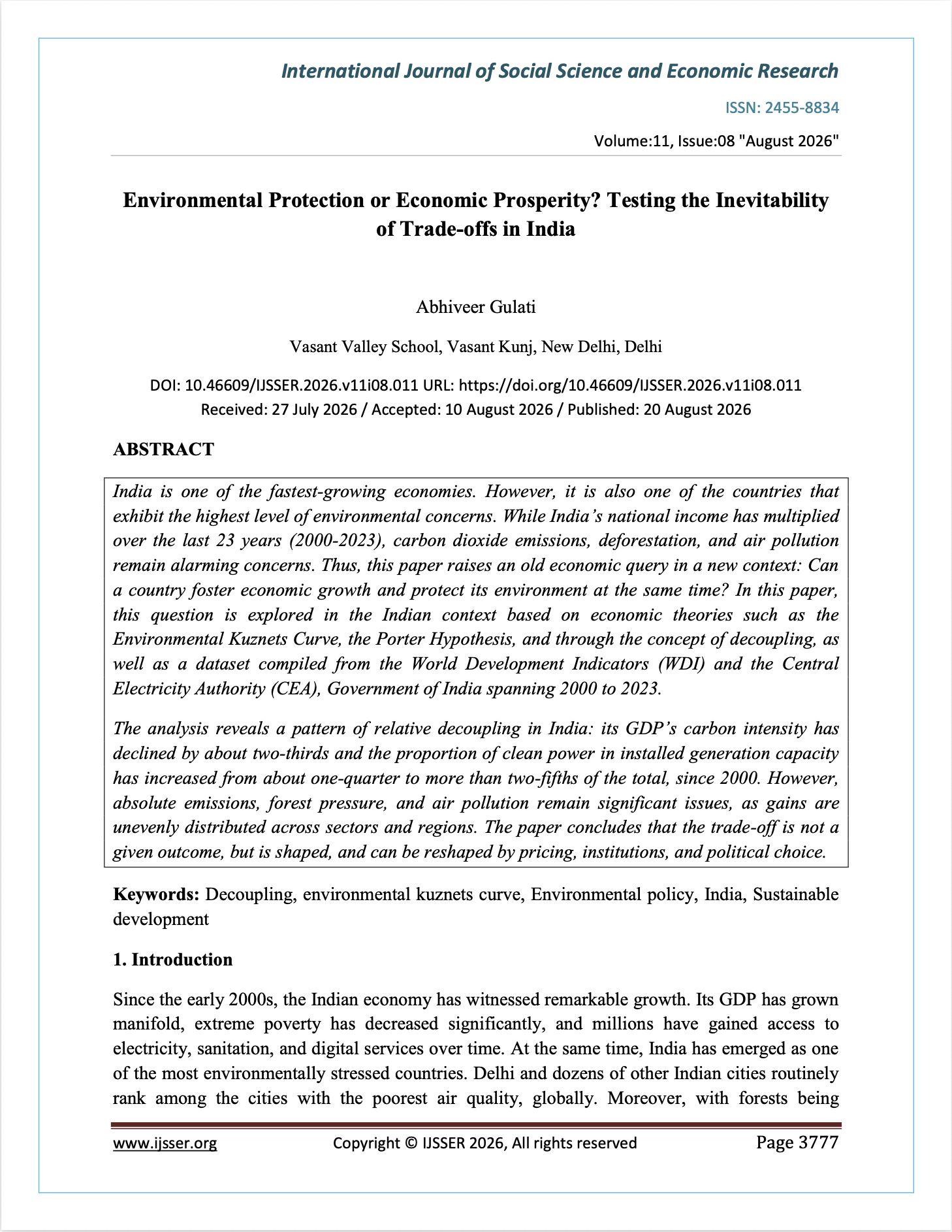
Paper cover — Environmental Protection or Economic Prosperity?

Environmental Protection or Economic Prosperity?

Are the trade-offs really inevitable?

International Journal of Social Science and Economic Research  |  August 2026

Economic growth and environmental protection are often presented as competing choices. I wanted to test whether that assumption holds in India.

The paper investigates the relationship between environmental protection and economic prosperity through ideas including externalities, environmental regulation, decoupling, innovation, policy design and institutional frameworks.

Supervised by a PhD Scholar, BITS Pilani, India.

The Question

Can an economy continue to grow without environmental damage increasing at the same pace?

The Bigger Idea

The relationship between growth and environmental protection is not fixed. Policy design, institutions, incentives and political choices can change the trade-off itself.

Read the Paper→
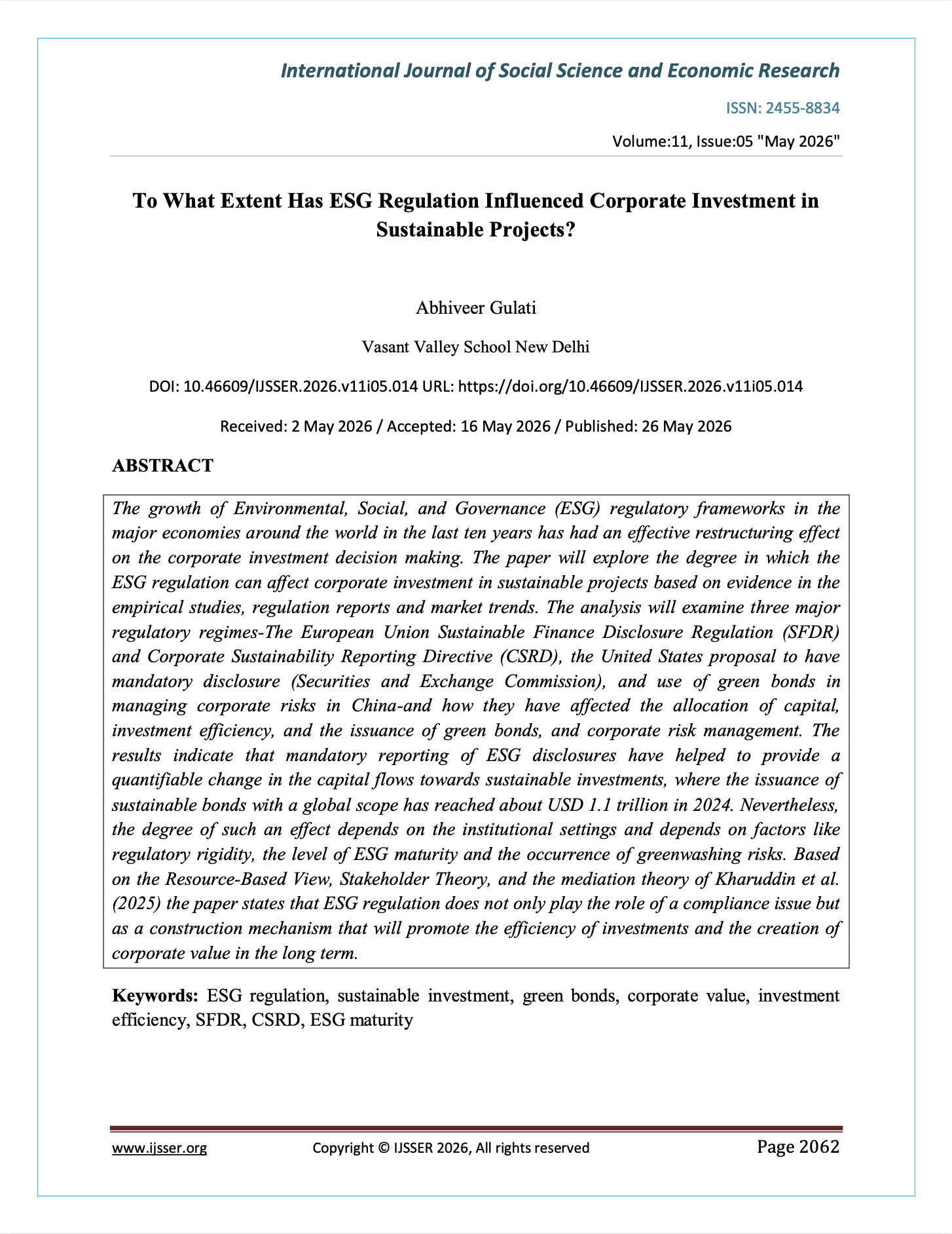

Paper cover — ESG Regulation & Sustainable Investment

ESG Regulation & Sustainable Investment

Does regulation change where companies invest, or only what they disclose?

International Journal of Social Science and Economic Research  |  May 2026

My interest in environmental policy led to a related question about capital. If governments introduce stronger ESG regulation, does corporate investment actually move towards sustainable projects? Or do companies simply become better at reporting?

Supervised by my Economics teacher at school, I examined regulatory approaches across the European Union, United States and China, looking at how institutional design, disclosure requirements and market maturity influence sustainable capital allocation.

What interested me most was not whether regulation ‘works’ in the abstract, but why the same regulation can produce different outcomes in different systems.

The Question

Can ESG regulation influence real investment behaviour?

The Finding

The evidence suggested that regulation can influence sustainable capital flows, but its effectiveness depends heavily on the institutions around it, including regulatory strength, market maturity and the risk of greenwashing.

Read the Paper→

Research In Practice

BEFORE A POLICY CAN BE EVALUATED, SOMEONE HAS TO DECIDE WHAT TO MEASURE.

01FIELD RESEARCH

Climate-Smart Agriculture

Student researcher to Ishawar Choudhary, Ph.D. Scholar,
BITS Pilani (Pilani Campus)  |  June 2025 – December 2025

I supported research examining the adoption of climate-smart agricultural practices and their relationship with farmer income in arid and semi-arid Rajasthan.

My work began with an extensive literature review and moved into the design of the primary research. I assisted with the survey framework, sampling methodology, respondent-selection criteria, sample-size planning and the development of the questionnaire.

The questionnaire explored household characteristics, adoption of climate-smart practices, farming income, irrigation access and agricultural credit. I also worked with sampling and estimation concepts to think through how a survey of farmers could produce evidence that was representative enough to support wider conclusions.

The research introduced me to practices ranging from drip and micro-irrigation to greenhouse cultivation, crop diversification, inter-cropping and rainwater-harvesting farm ponds, and to the larger question of how their adoption might affect agricultural productivity and farmer welfare.

Line drawing of farmland, hills, trees and sun
FARMERS
PRACTICES
EVIDENCE
STRONGER LIVELIHOODS

WHAT I WORKED WITH

Literature review•Survey design•Sampling methodology•Sample-size planning•Questionnaire design•Estimation & inference

The experience introduced me to the less visible part of research: how decisions about what to measure, whom to survey and how to sample ultimately shape what the evidence can tell you.

02POLICY RESEARCH · RESEARCH IN PRACTICE

Policy Research at Sambodhi

From a large policy question to evidence you can use.

At Sambodhi, I worked alongside research teams studying two different development challenges: India’s transition from coal to clean energy and agricultural productivity, livelihoods and climate resilience in Uttar Pradesh.

My work included literature review, stakeholder mapping, secondary research and supporting the development of research tools.

For the ClimateWorks Foundation study, that meant understanding how questions of funding, institutions and political economy shape the transition from coal to clean energy.

For the UP-AGREES programme, that meant seeing how early research feeds into a theory of change, monitoring and evaluation framework, household survey design and stakeholder interviews.

Evidence does not simply appear at the end of a study. It is shaped by the questions researchers choose to ask at the beginning.

Explore Sambodhi Internship→

HOW THE WORK MOVED

Larger policy questions
↓
Research and data
↓
Analysis and frameworks
↓
Evidence you can use

Econometrics

A SEPARATE STRAND: METHODS & TRAINING.

When an argument becomes testable.

At Ashoka University’s Econometrics Essentials programme, I began working with real datasets using RStudio, applying concepts such as regression, OLS estimation, statistical significance and model interpretation.

My capstone used real-world data to examine the relationship between parents’ education and children’s educational outcomes.

Those methods later became useful in my published ESG research.

I like the discipline of having to ask: what do the numbers actually prove, and what do they not?

Yᵢ = β₀ + β₁Xᵢ + εᵢ

Select Writing on Policy

DIFFERENT QUESTIONS. A SHARED THEME: HOW ECONOMICS SHAPES PEOPLE’S LIVES.

The Profit Motive

John Locke Essay Competition 2025
Shortlisted Finalist  |  Top 18%

When does profit create progress, and when does it create costs society has to absorb? I explored the tension between market incentives, innovation, human welfare and regulation, arguing for markets that retain the efficiency of the profit motive while accounting for its social and environmental externalities.

View Essay→

AI, Inequality & Redistribution

Harvard Undergraduate Economics Association
High School International Economics Essay Competition 2026
Published by Critical Debates in Humanities, Science and Global Justice Journal, September 2026

A drone can deliver your dinner in twenty minutes. Yet, for millions, the question of where the next meal comes from remains unanswered. As automation reshapes work and data becomes the new currency of wealth, the gap between tech's stupendous progress and humanity's basic survival has never been starker. My piece asks whether Universal Basic Income and data dividends can bridge it, and what it would actually take to make them work.

View Article→

The Questions Are
Starting to Connect.

NCR Clean Air Campaign led me to corporate investment.

Corporate investment led me back to institutions.

Climate transition raised questions about livelihoods.

Agricultural research raised questions about how evidence gets translated into policy.

The subjects change. The pattern does not.
I keep coming back to questions about how incentives, institutions and policy shape what happens in the real world, who benefits from those choices, and whether their impact reaches the people who need it most.

DIFFERENT QUESTIONS
A MORE CONNECTED WORLD